

After the Pile-Up: What Your Series A Lead's Lawyer Actually Sees
You've spent months getting to this term sheet. You've pitched, you've followed up, you've answered every question about your TAM and your roadmap and your unit economics. The lead partner says yes. The deal moves to diligence.
And then their lawyer opens your cap table.
This is the moment most founders don't think about — and it's the moment that determines whether your round closes in three weeks or three months. Because the lawyer on the other side isn't reading your cap table the way you read it. You see a history of successful fundraises. They see a document that either confirms you've been building your company intentionally or suggests you've been winging it.

The SAFE Pile-Up: How Three "Simple" Agreements Became a Dilution Bomb
Millie built a strong product. She had paying customers, a clear wedge into her market, and three investors who believed in her early enough to write checks when nobody else would. Over fourteen months, she raised $750,000 across three SAFEs. Each one felt small. Each one felt reasonable. Each one was a post-money SAFE — the standard YC instrument that 90% of pre-seed founders are signing right now, according to Carta's Q1 2025 data.
Then she got a term sheet.
Her Series A lead offered $3 million at a $12 million post-money valuation. Solid terms for a company at her stage. She ran the mental math in her head: 25% to the new investor, 15% option pool, maybe another 6% or so to the SAFE holders. She figured she'd keep somewhere around 55%.
She kept 40%.
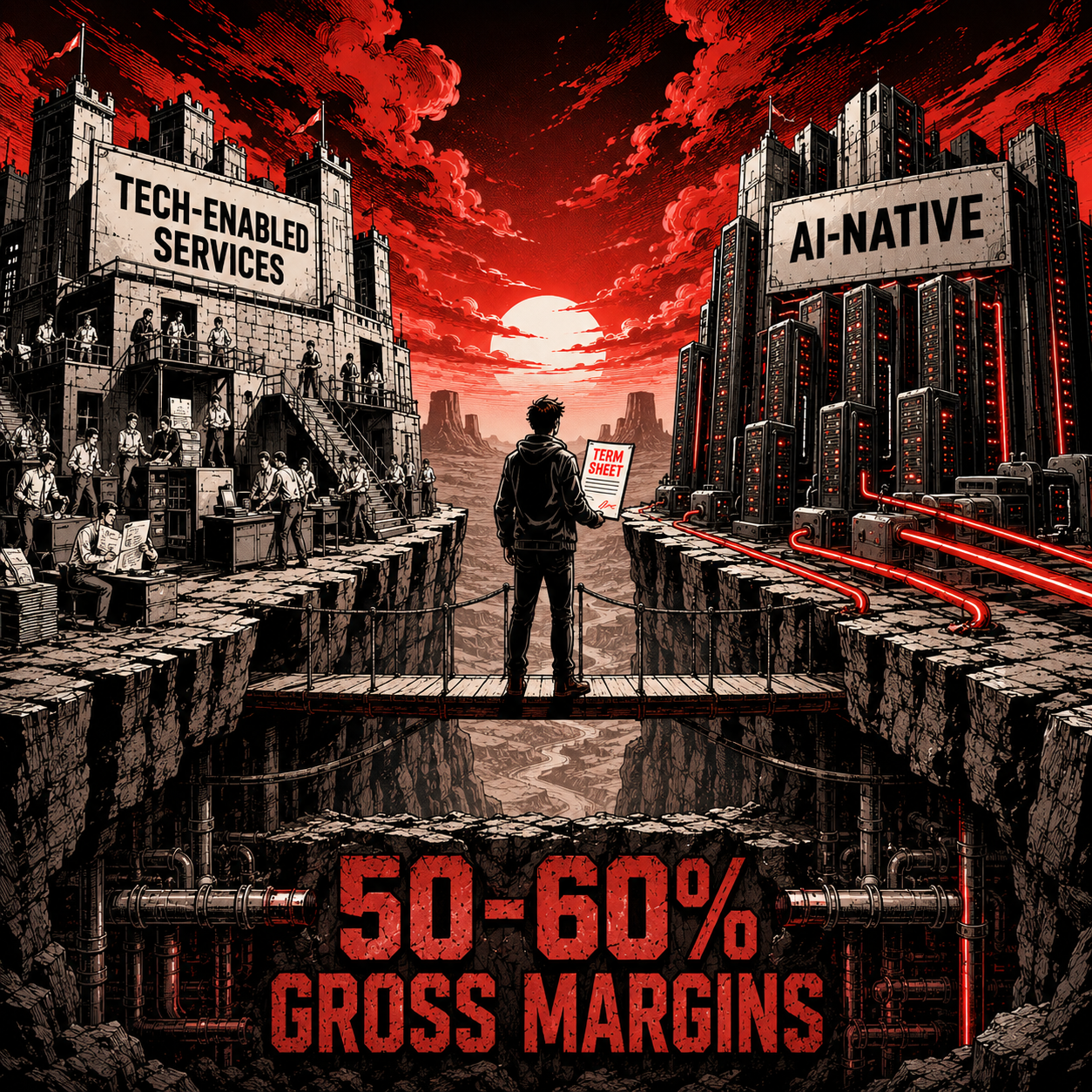
Is AI Software? The $230,000 Question Hiding in Every Revenue Dollar.
There's a comfortable assumption sitting underneath every services-as-software pitch deck. It goes like this: the AI delivers the work, so there are no humans on payroll, so the gross margins should be at least as good as traditional software — maybe better, because you're capturing the full value of a service without the labor cost.
It's wrong. The data showing it's wrong is now public, structural, and getting worse on the timescales most founders are pricing rounds on. If you took anything from Part 1, you should be asking the obvious follow-up: if Sierra and Greenlite both deliver outcomes, why is one priced like software and the other priced like a services firm? The answer, which most founders never get told before they sign a term sheet, is that they actually have similar gross margins. The difference is which one is allowed to claim software multiples in the market right now.
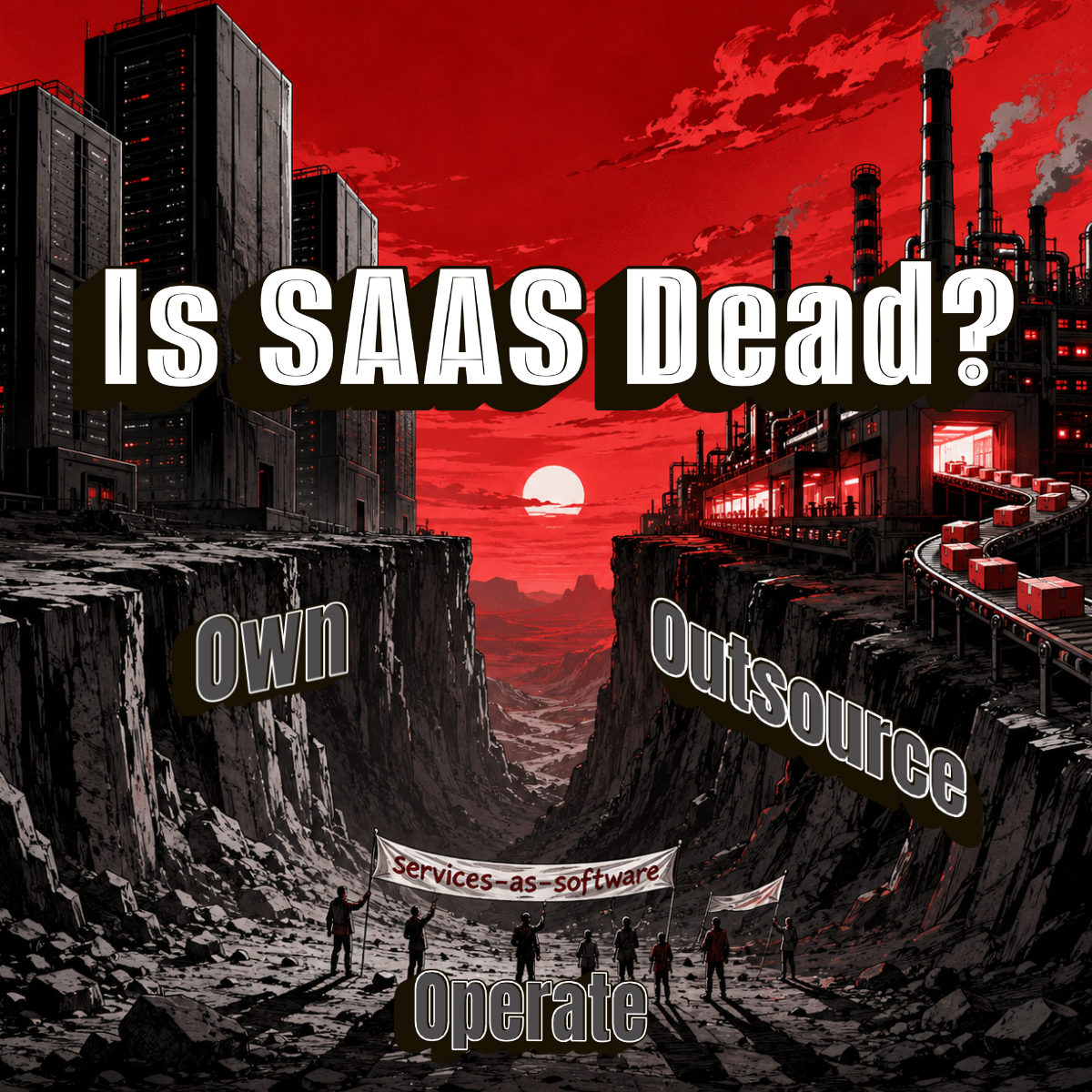
Is SaaS Dead? The $2 Trillion Question Hiding in Every AI Pitch Deck
VCs have repositioned around AI-native companies that don't sell tools — they sell outcomes. Services-as-software (SaS). A new category for a new era, sold to LPs as the answer to the SaaS multiple compression problem.
Here's the problem: most of the companies pitched into that category aren't services-as-software. They're tools dressed up in outcome language.
Here's a founder-grade test that will tell you which side of the line your company is actually on — before a Series B diligence partner does it for you.

Welcome to America, Where You Can Buy a Company—But Not Run It
The Nippon Steel deal may be remembered as a turning point not just for industrial policy, but for how the U.S. is perceived by global investors. In a geopolitical moment defined by economic competition and fragmented alliances, the U.S. must choose: will it lead by example as an open, rules-based economy or slide into the very model of conditional capitalism it has long criticized in others?
The golden share may be strategic. But unless applied with extreme caution, it could prove to be short-sighted, self-defeating, and a poor trade for long-term investment leadership.

Meta's Absorption of Scale AI Talent: Strategic Leap or Antitrust Red Flag?
Meta Platforms' nearly $15 billion investment in Scale AI has garnered attention not only for its size, but for its structure: v Meta receives a 49% stake paired with the absorption of Scale AI's CEO Alexandr Wang and key research personnel.
Unlike other high-profile AI investments—such as Microsoft's stake in OpenAI or Amazon's in Anthropic— Scale AI's CEO and research personnel will be Meta employees despite Meta being a “minority shareholder” in Scale AI. This move further blurs the line between strategic partnership and acquisition. This blog explores the regulatory implications of Meta's approach, especially the role that executive and technical talent transfers may play in inviting legal scrutiny.

Doomed to Fail: The Limits of Musk’s Case Against the WFA
X Corp. (formally “Twitter”) has sued the World Federation of Advertisers (WFA) and a number of member companies for orchestrating an illegal boycott of Twitter. X Corp. v. World Federation of Advertisers. The complaint asserts that it is “an antitrust action relating to a group boycott by competing advertisers of one of the most popular social media platforms in the United States.” The lawsuit premise of this (forcing advertisers to do business with a floundering company using antitrust law) is absurd, and should not survive summary judgment (initial motions).