
I Moved for Partial Summary Judgment Against a Fortune 100 Company. A Database Told Me I Was Ready.
I'm representing myself pro se. Opposing counsel is an in-house legal department plus a white-shoe Philadelphia firm. They have headcount, budget, and institutional infrastructure.
When I filed for partial summary judgment, I wasn't guessing. I opened a dashboard, looked at two counts sitting at full element coverage, and could see every fact supporting every element, where it came from and how strong it was. I felt comfortable that nothing was missing.
That's an aggressive posture for one attorney against a company that size. I took it because I could see the whole board.
This post is about the tool that let me see it, what it does, what it emphatically does not do, and why I'm looking for other litigators to break it.
The Problem Every Lawyer Knows
You bring a complaint with multiple causes of action. Each cause of action has discrete elements — the things you actually have to prove. Each element needs evidentiary support from somewhere in the pile the other side just produced.
So you sit down with thousands of pages of Bates-stamped production, interrogatory responses, requests for admission, spreadsheet exhibits, and call recordings, and you start cross-referencing by hand.
You read a document thinking, this is relevant to the breach of contract claim. But also maybe the bad faith claim. And possibly the fiduciary duty count, depending on how you frame the element. So you note it in three places. Then you find another document that says something slightly different, and now you need to work out whether it supports or undermines the first one. You note that too. Somewhere.
Three hours in, you've reviewed maybe 200 pages, your spreadsheet has 40 rows, and you're already unsure whether you captured everything from the first batch. You haven't started thinking about which elements still have gaps. You'll do that later, when you can see the whole picture. Except the whole picture changes every time you open another document.
This is the work. Not the legal analysis. Not the strategy. Not the argument. The infrastructure underneath all of it — the evidence map connecting what you have to what you need to prove.
Every litigator builds some version of it. Against a well-resourced opponent, building it badly isn't an option. You either build it right, or you miss something they don't.
Variant A — Beta waitlist (recommended, mid-article)
Litigation Fact Tracker — Founding Testers
I built it. Now I want you to break it.
The MVP goes out to a small founding group of litigators, legal ops professionals, and litigation support teams — real matters, real document productions, honest feedback. Founding testers get direct access to me and direct influence over what gets built next.
Beta invitations and build updates only. Unsubscribe anytime. This is not legal advice and does not create an attorney-client relationship.
The Case
Eight counts: breach of fiduciary duty (two counts, distinct theories), breach of the implied covenant of good faith and fair dealing, breach of contract, UTPCPL consumer fraud, declaratory judgment, statutory bad faith under 42 Pa. C.S. § 8371, and conversion/unjust enrichment.
Forty-one discrete provable elements across those eight counts.
Discovery: 1,635 Bates-stamped pages, plus interrogatory responses, requests for admission, spreadsheet exhibits, call recordings, regulatory correspondence, and annual policy statements spanning more than a decade.
A mid-size firm assigns two or three associates to build an evidence matrix on a case this size. I had myself and a database.
Three working sessions. About six hours. 184 extracted facts. 181 fact-element links. A complete evidentiary map of an eight-count case.
That same work billed at associate rates runs 40 to 60 hours. I did it over a weekend.
What Changes
The time compression isn't the story. The story is what became possible.
You always know where you stand. Every count carries a coverage percentage. Every element shows how many facts support it, how many undercut it, and how strong each one is. Not a feeling about whether a claim is ready — a number, updated the moment you log a new fact.
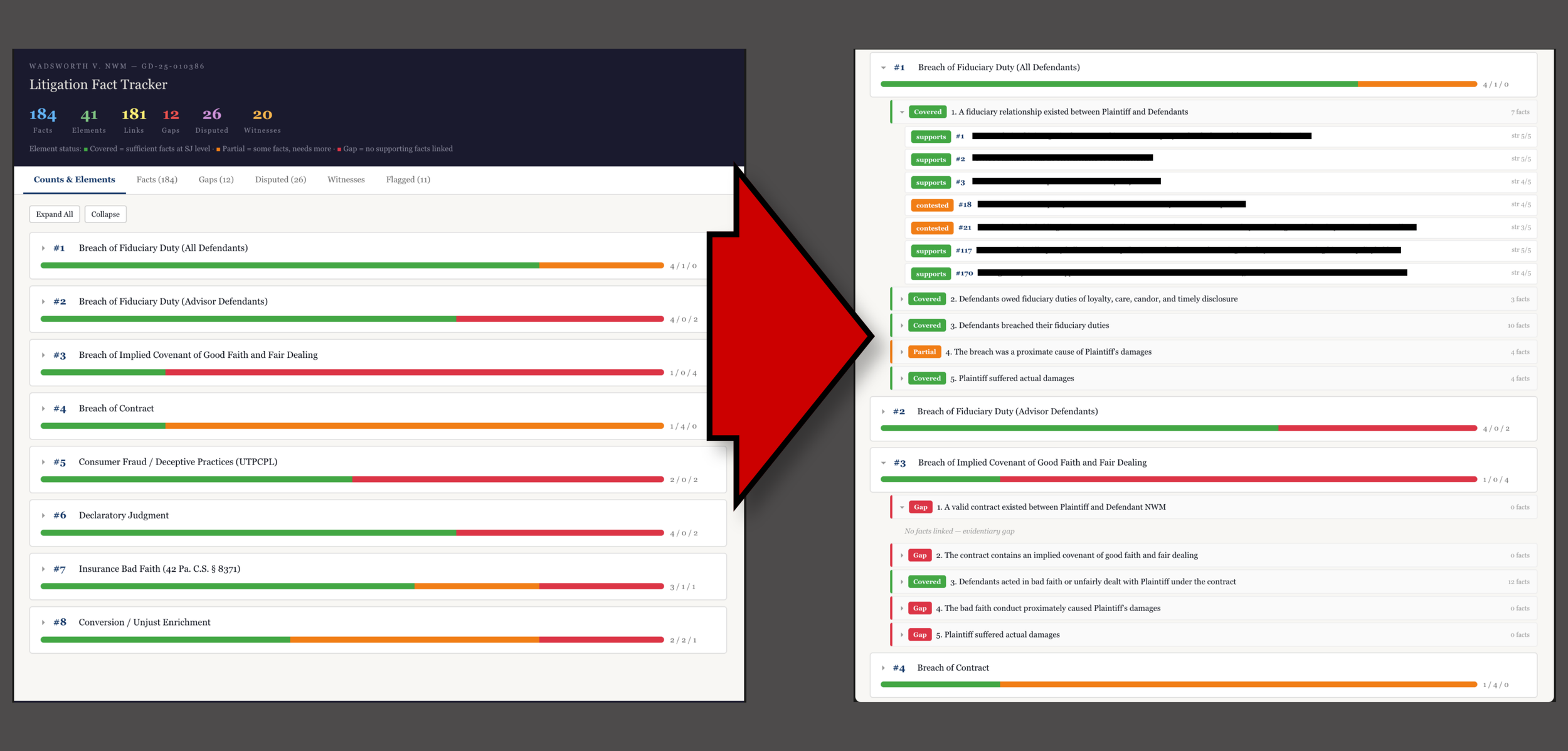
You always know what's missing. The gaps surface themselves. Elements with zero supporting facts appear in their own view instead of waiting to be discovered three days before a filing deadline. When you're outnumbered, your discovery motions have to be surgical rather than broad. Gap analysis is what makes them surgical.
Nothing gets lost across claims. One document can support a contract claim and undercut an affirmative defense at the same time. In a spreadsheet, that fact lives in one row and you hope you remember the rest. Here it links to every element it touches, in both directions, with a strength score on each link.
Your undisputed-facts statement writes itself from the map. You don't hunt for the evidence supporting each element. You query for it.
None of that is faster spreadsheet work. It's a different kind of visibility — the kind that normally requires a team, packaged into something one attorney can run.
I'm not outspending anyone. I'm out-organizing them.
Under the Hood
A relational database that mirrors the structure of litigation: counts contain elements, evidence contains facts, and every fact links to the elements it touches with direction and strength attached. An AI layer that does first-pass extraction. A dashboard on top.
The database is the memory. The AI is the extraction engine. The attorney decides what it all means.
What the Tool Doesn't Do
This is the section that makes or breaks credibility, so I'll be specific.
It doesn't decide legal sufficiency. The tool can tell you an element has four supporting facts at strength 4 or higher. Whether that's enough to survive summary judgment is a judgment call, and it's yours. The tool shows you the evidence. You assess whether it carries the burden.
It doesn't replace close reading. Extraction accuracy is high, but the AI over-includes marginal material, misses implications that require case-specific knowledge, and sometimes misreads what a statement actually means. Every extraction needs attorney review. The pipeline accelerates the work. It does not automate the judgment.
It doesn't get citations right. In adjacent motion-drafting work, the AI fabricated two case citations — a real case given the wrong reporter and volume, and a quote attributed to an opinion that never contained it. Both looked entirely plausible. Every legal citation requires independent verification, every time, without exception. If a tool tells you otherwise, close the tab.
It doesn't own your element decomposition. The MVP will draft a first-pass breakdown of your complaint into provable elements. That's a real accelerant — it's the step most litigators shortcut because the document pile feels more urgent, and skipping it is what makes everything downstream noise instead of signal. But a drafted decomposition is a starting point, not an answer. The elements you actually have to prove, under your jurisdiction's law, with your theory of the case, are yours to set. The tool gets you to the first draft in minutes instead of hours. You still have to be right.
It doesn't draft arguments. The output is an evidentiary map, not a brief. Turning coverage data into a persuasive argument is a different skill entirely. But having every relevant statement the other side made — organized by element, tagged by direction, sitting in front of you while you write — makes that skill considerably more effective.
What I'm Building Next
I built this for my own case and it did what I needed it to do. Now I want to know whether it holds up on matters that aren't mine.
I'm building an MVP as a standalone tool. Same core architecture — structured element decomposition, AI-assisted extraction with attorney review, relational evidence mapping, real-time gap analysis — plus a semantic layer that maps deeper connections between facts, and between facts and case law. The current version tells you which facts support which elements. The next one surfaces relationships you didn't think to query for.
I'm looking for a small founding group of testers:
Litigators handling cases with multiple causes of action and substantial document productions
Legal ops professionals managing discovery workflows and evidence organization
Litigation support teams building fact chronologies, evidence matrices, and trial-preparation databases
Founding testers get direct access to me, direct influence over what gets built next, and the MVP on real matters before anyone else. What I want in return is honesty: what breaks, what's missing, what you'd change.
This was built to solve a real problem on a real case against an opponent with far more resources than I have. I want to find out whether it solves yours.
Curt Wadsworth is a Pennsylvania-licensed attorney (J.D., Ph.D.) and the founder of Nerd Lawyer Entrepreneur Services (nerdlawyer.ai), an AI-native corporate and IP law firm. He builds AI-powered legal tools because he got tired of building bad spreadsheets.